
How Does an Online Live Casino Work?
 Nathan Williams
An online live casino is a platform where real human dealers operate physical casino games in professional studios, with every action streamed to players' devices in HD or 4K in real time. The player places bets through a digital interface while watching a live video feed of the dealer dealing cards, spinning wheels, or managing game show mechanics. The experience combines the rules of traditional casino games with the convenience of playing from any device.
This guide explains the full mechanics behind live casinos: the studio infrastructure, the streaming technology, the software systems that translate physical actions into digital data, and the practical details that determine what the player sees on screen.
What Is a Live Casino?
A live casino is a section of an online casino where games are hosted by real dealers in real time rather than by software algorithms. The dealer sits at a physical table in a purpose-built studio, handles real cards or spins a real wheel, and interacts with players through a live video stream and text chat.
Players access the games on their mobile phones or computers in real-time. These games are streamed in HD (High Definition) video, although some studios, such as Playtech, support 4K streaming.
The key distinction from RNG (Random Number Generator) games is that live casino outcomes are determined by physical actions (a card deal, a wheel spin, a ball drop) rather than by software algorithms. Both formats are fair at licensed operators, but live casino adds visual transparency because the player watches the outcome happen on camera.
The Studio: Where Everything Happens
Live casino games are broadcast from dedicated studios designed to replicate the look and feel of a land-based casino floor. These studios are purpose-built facilities equipped with professional lighting, casino-grade tables, and multiple camera positions. Some providers also stream from sections of actual land-based casinos.
Evolution Gaming operates the largest network of live casino studios globally, with facilities across Europe, North America, and Asia. In the US market alone, Evolution launched studios in New Jersey, Pennsylvania, and Michigan to serve regulated state markets. Playtech, Pragmatic Play, Ezugi, Vivo Gaming, and other providers maintain their own studio networks across multiple jurisdictions. Some providers, like Ezugi, operate studios in emerging markets, including Colombia and Argentina, while Evolution's primary international hub operates from Malta.
A typical studio contains multiple tables running simultaneously, each managed by a trained dealer and monitored by a floor manager. The environment is controlled to ensure consistent lighting, sound, and camera angles across all tables. Background elements, including monitors displaying live news feeds, confirm to players that the stream is broadcasting in real time and is not pre-recorded. Studios operate around the clock with dealers working in shifts, ensuring continuous availability regardless of the player's time zone.
How Casino Real-Time Streaming Works
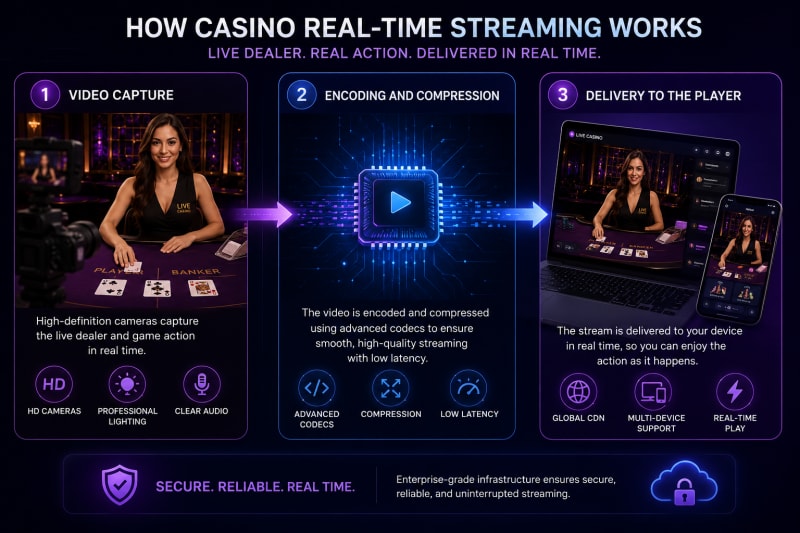
Real-time streaming is the core technology that makes live casino possible. The process involves three stages: capture, encoding, and delivery.
Stage 1: Video Capture
Studios use multiple professional-grade cameras positioned at each table to capture the game from several angles simultaneously. A typical roulette table uses three cameras: one for a wide table overview, one zoomed on the wheel, and one for a picture-in-picture display. Blackjack tables typically use two to three cameras covering the dealer, the cards, and the full table layout.
These cameras are omnidirectional and compact, designed to capture every action in the game without obstructing the dealer's workflow.
Stage 2: Encoding and Compression
Raw video from the cameras is processed by the Game Control Unit (GCU), a device roughly the size of a shoebox attached to each table. The GCU encodes the video feed into a compressed format suitable for internet transmission. Think of GCU as the Central Processing Unit (CPU) of the live studio, responsible for ensuring the games are streamed in real time without any glitches.
The encoding process balances video quality against bandwidth requirements. HD streaming (1080p) requires a minimum download speed of approximately 10 Mbps from the player's side. 4K streaming, available at Playtech studios, delivers sharper visual detail but requires higher bandwidth.
Stage 3: Delivery to the Player
The encoded stream is transmitted from the studio's servers to the player's device through the casino's content delivery network. Players connect via web browsers or dedicated casino apps. The stream arrives with minimal latency, typically under 2 seconds, allowing the player to watch the dealer's actions and respond within the timed betting window.
The player's actions (bet placement, hit/stand decisions, chat messages) are sent back to the studio in real time, creating a two-way communication loop. The dealer sees these actions on their monitor and responds accordingly.
The Technology Stack Behind Every Table
Four core technologies work together at every live casino table to translate physical game actions into the digital experience the player sees on screen.
Optical Character Recognition (OCR)
OCR is the system that converts physical game events into digital data. When a dealer deals a card, OCR software reads the card's value through embedded sensors or camera recognition and translates it into data displayed on the player's interface. OCR software is what is used to recognize numbers and values on cards and in other aspects of gameplay. These values are then represented on the user interface.
In roulette, OCR reads the winning number from the wheel using optical sensors. In blackjack, it reads each card as it is dealt. In baccarat, it tracks the full hand progression. The player's screen updates automatically with hand totals, winning numbers, and payout calculations, all derived from the OCR data.
Game Control Unit (GCU)
The GCU is the central processing device at each table. It manages video encoding, processes OCR data, synchronizes the dealer's actions with the player's interface, and ensures that bets are recorded accurately before each round begins. Without the GCU, the live stream and the betting interface would not be synchronized.
RFID Chips and Sensors
Casino tables in live studios use RFID-enabled chips and embedded sensors to track chip placement and bet amounts. Roulette wheels contain built-in sensors that communicate with the casino software to independently confirm the winning number, regardless of the dealer's announcement. These sensors provide an additional layer of verification on top of the OCR system.
Chat and Communication Systems
The dealer communicates with players through audio (the player hears the dealer speak) and video (the player sees the dealer on camera). Players communicate back through a text-based chat interface built into the game window. The dealer reads chat messages on their monitor and responds verbally or through text. A live chat operator is also typically available for technical support. Read our guide on how to behave using live casino chat if you want to learn more about the casino etiquette.
The Live Dealer: Training and Role
The dealer is the human element that defines the live casino experience. Live casino dealers are trained professionals who must know the rules of every game they host, manage the pace of play, interact with players through chat, and handle any irregularities under the supervision of a floor manager.
Dealer training covers game rules, card handling, chip management, interaction with the OCR system, and customer communication. Studios retrain their dealers regularly to maintain consistent quality. The dealer also uses a monitor that displays the current bets, active players, and chat messages, enabling them to manage the table efficiently.
What the Player Sees on Screen
The player's screen combines the live video feed with a digital betting interface. The layout includes several elements that work together.
Element | Function |
|---|---|
Live video feed | Real-time stream of the dealer and the table |
Digital betting grid | Interactive layout for placing inside and outside bets |
Chip selector | Allows the player to choose bet denominations |
Betting timer | Countdown showing when the betting window opens and closes |
Game history | Record of recent results (previous winning numbers, hands) |
Statistics panel | Trends, hot/cold numbers, and other optional data displays |
Racetrack view | Oval layout mirroring the wheel order for neighbour bets (roulette) |
Chat window | Text input for communicating with the dealer and other players |
The interface is fully responsive, adapting to desktop, tablet, and smartphone screens. On mobile devices, the layout is compressed but retains all core functions, including bet placement, chat, and game history.
Fairness, Regulation, and Licensing
Live casino games are subject to the same regulatory oversight as any other form of online gambling. Studios must hold valid licenses from recognized regulatory authorities, and games are monitored for compliance with fairness standards.
Every physical action in the studio, from card shuffling to wheel spinning, is captured by multiple cameras and processed through OCR and GCU systems, creating a verifiable audit trail. This transparency is one of the primary reasons players trust live casino games.
Independent testing laboratories, including eCOGRA, iTech Labs, and GLI, audit live casino operations to verify that game outcomes are consistent with published probabilities. Regulatory bodies, including the UK Gambling Commission, Malta Gaming Authority, and Gibraltar Regulatory Authority, oversee studio licensing and ongoing compliance.
How Live Casino Differs From a Land-Based Casino
Live casino replicates the core experience of a land-based casino but differs in several practical dimensions.
Feature | Live casino (online) | Land-based casino |
|---|---|---|
Dealer | Real person, streamed via video | Real person, physically present |
Equipment | Physical tables, wheels, cards in a studio | Same, on the casino floor |
Access | 24/7 from any device with internet | Casino operating hours, travel required |
Minimum bets | From $0.10 (Auto Roulette) to $1+ | Typically $5 to $25 |
Social interaction | Text chat with dealer and players | Face-to-face conversation |
Game variety | European, French, Lightning, Speed, Immersive, game shows | Typically European and American only |
Atmosphere | Studio-designed, consistent lighting and sound | Ambient casino floor, crowd noise |
Bet placement | Digital interface, tap or click | Physical chips placed by hand |
The most significant advantage of live casino is accessibility: lower minimum bets, wider game selection, and 24/7 availability without travel. The most significant advantage of land-based casinos is atmosphere: the physical presence of other players, the ambient sound, and the tactile experience of handling chips.
Final Thoughts
An online live casino works by streaming real dealers managing physical games from professional studios to your device in real time. The technology stack behind it, including HD cameras, OCR, GCU, RFID sensors, and content delivery networks, translates every physical action into a seamless digital experience. The rules, payouts, and house edge are identical to those of land-based casino games.
The system is designed for transparency. You see the cards dealt, the wheel spun, and the result determined by a real person in front of multiple cameras. The combination of physical game mechanics and digital delivery is what makes live casino the fastest-growing segment in online gambling, and understanding how it works is the first step to using it well. Explore our live casino guides to get more insights into this innovative form of gambling.
Frequently Asked Questions
How does an online live casino work?
An online live casino streams real dealers running physical games from professional studios to your device in HD or 4K. You place bets through a digital interface while watching the dealer deal cards or spin wheels in real time.
What is the Game Control Unit (GCU) in a live casino?
The GCU is a device attached to each table that encodes the video feed, processes OCR data, and synchronizes the dealer's actions with the player's betting interface. LiveCasinoRank describes it as "the CPU of the live studio."
What internet speed do I need for live casino games?
A minimum download speed of 10 Mbps is recommended for HD live casino streaming. 4K streaming requires higher bandwidth. A stable Wi-Fi or mobile data connection is essential to avoid lag or disconnection during play.
Are live casino games fair?
Yes, at licensed operators. Physical outcomes are captured by multiple cameras and processed through OCR and GCU systems, creating a verifiable audit trail. Independent labs, including eCOGRA, iTech Labs, and GLI, audit live operations for compliance with published probabilities.
What is the difference between live casino and land-based casino?
Both use real dealers and physical equipment with identical rules and house edges. Live casino offers lower minimum bets (starting at $0.10), a wider selection of variants, and 24/7 access. Land-based casinos offer physical atmosphere and face-to-face interaction.
What technology makes live casino streaming possible?
Four core technologies power every live table: omnidirectional HD cameras capture the action, the Game Control Unit (GCU) encodes and synchronizes the video, OCR software translates physical card values into digital data, and RFID sensors verify results independently.
What is OCR technology in live casino games?
Optical Character Recognition (OCR) reads card values and game results using embedded sensors or camera-based recognition, then converts them into digital data displayed on the player's screen. It updates hand totals, winning numbers, and payouts automatically.
Where are live casino studios located?
Major providers operate studios across multiple countries. Evolution has facilities in Europe, North America, and Asia, including US studios in New Jersey, Pennsylvania, and Michigan. Playtech, Pragmatic Play, and Ezugi maintain their own studios in additional jurisdictions.
How are live casino dealers trained?
Live casino dealers undergo professional training covering game rules, card handling, OCR system interaction, and customer communication. Studios regularly retrain dealers, and a floor manager supervises each table to address any irregularities.
What do I see on screen when playing live casino?
Your screen combines the live video feed with a digital betting grid, chip selector, betting timer, game history, statistics panel, racetrack view for neighbor bets, and a chat window for communicating with the dealer.